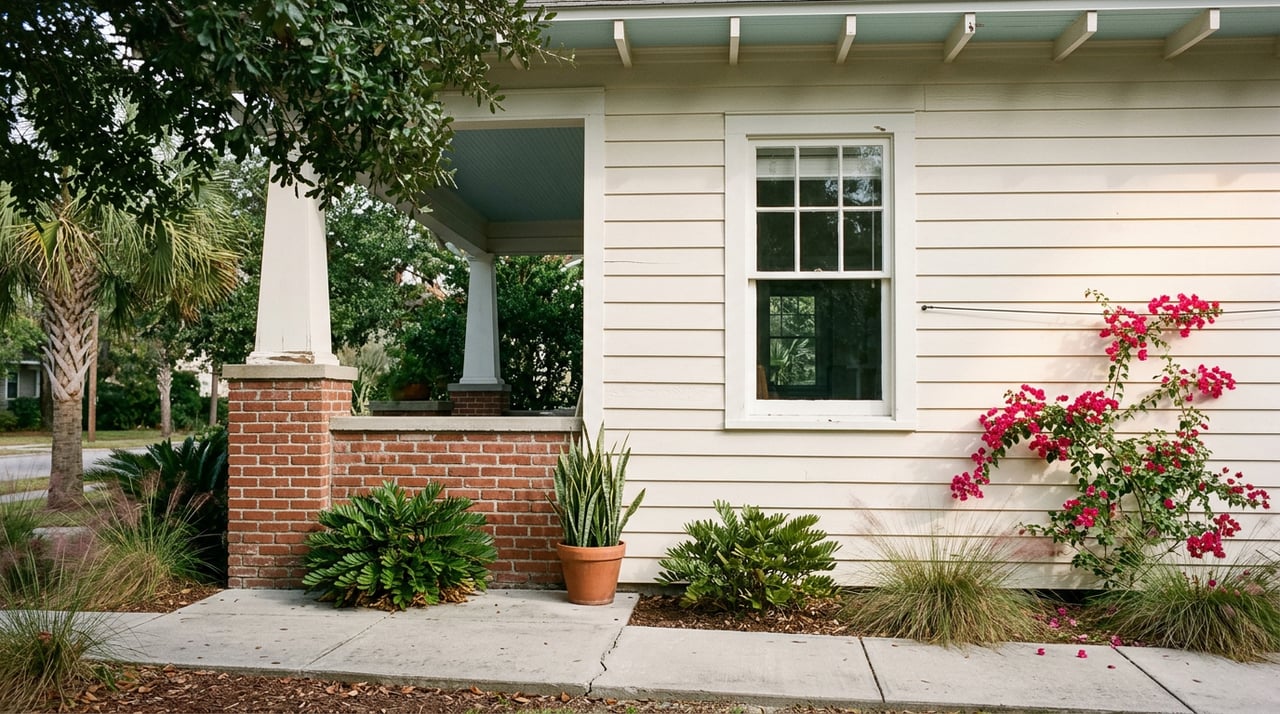
Two buyers stand on the same brick block in Historic Old Northeast, looking at two 1924 bungalows across the street from each other. Same square footage. Same original heart pine floors. Same asking price. One of them can replace the original wood sash windows next spring. The other one cannot, at least not on the front elevation, and not without a two-to-four month review that has to be complete before the permit gets pulled.
Both houses sit inside the same neighborhood most people call Old Northeast. Only one sits inside a locally designated historic district. That distinction is the single most useful piece of information a buyer can carry into an Old Northeast showing, and it almost never shows up on a listing sheet.
National Register vs. St. Petersburg Register: the line that actually matters
Old Northeast, officially the Northshore Historic District, was designated in 2003 as a landmark in the National Register of Historic Places, and it is one of Preserve the 'Burg's five National Register districts in the city. For a private residential owner, that listing is largely honorary. It does not, by itself, require design review, prevent exterior changes, or block a demolition permit.
Local designation is a different animal. Under St. Petersburg City Code Section 16.30.070, any exterior alteration to a locally designated landmark or a property within a locally designated historic district requires a Certificate of Appropriateness before the permit is issued. Exterior alteration is defined broadly and includes changes to walls, roof, and windows, painting previously unpainted masonry, additions, relocation, and demolition. Interior work is not subject to the review at all.
That distinction is why two bungalows a hundred feet apart can carry very different renovation math.
Which pockets of Old Northeast are locally designated
Most of Old Northeast carries only the honorary National Register status. Inside the neighborhood, only a handful of smaller pockets and individual properties fall under the stricter local rules. Ask the City's Urban Planning and Historic Preservation Division about the specific parcel before you write an offer, and expect the local layer to include:
- Granada Terrace, the best-known locally designated subdivision inside Old Northeast, formally recognized by the City and cited by both HONNA and Preserve the 'Burg.
- Welch's Mediterranean Row, a one-block local historic district built out by the M.B. Welch construction firm whose 1920s work also shaped much of the surrounding blocks.
- A short list of individually locally designated landmarks scattered through the neighborhood.
- Non-contributing structures that happen to sit inside one of those local boundaries. Even a 1985 infill house inside a local district is subject to the same review process, though the standard the City applies to a non-contributing property looks at the impact on the district rather than the individual building, per Preserve the 'Burg's guidance.
Everything else in Old Northeast is inside the National Register district only. That is the majority of the neighborhood, and it means most Old Northeast buyers can renovate the exterior of their home without triggering city preservation review.
What actually needs a Certificate of Appropriateness
The COA question splits along two axes: where the property sits, and what part of the house you are changing. The short version:
| Property status | Interior work | Exterior work visible from a public way |
|---|---|---|
| National Register only (most of Old Northeast) | No COA | No COA |
| Locally designated, contributing | No COA | COA required |
| Locally designated, non-contributing | No COA | COA required, reviewed for district impact |
| Individually locally designated landmark | No COA | COA required |
The practical implication is that a buyer planning to gut a kitchen, reconfigure a primary bath, refinish original floors, or run new mechanicals almost never faces preservation review, even inside a local district. The friction lives at the street-facing envelope: windows, siding, roof material and profile, porches, front-yard fencing, additions, and paint on previously unpainted masonry.
The two-to-four month buffer you cannot compress
For properties that do fall inside a local district or carry local landmark status, timing is where the surprise usually lands. Minor projects that fit the design guidelines can be approved administratively by preservation staff at a pre-application meeting. Anything larger goes to the Community Planning and Preservation Commission, which meets on a fixed schedule.
Contractors who work these blocks routinely quote a two-to-four month buffer on top of standard permitting. Local historic renovation specialists at Revolution Contractors, who won a Preserve the 'Burg preservation award for a whole-house remodel in the area, describe the same timeline range and note that variance or board hearings can extend it further. Their advice, which mirrors what the City's application package says, is to schedule a pre-application meeting before the design is locked, not after.
Two other timing details are worth building into your calendar. Applications are accepted by email to [email protected], and pre-application meetings can be scheduled through the division at 727-892-5470 or 727-892-5451. Once a COA is approved, the corresponding building permit must be pulled within 18 months, per the City's application package. That window matters if you are planning a phased renovation or expect to close on the house before final construction drawings are ready.
The tax offset most listing sheets don't mention
Local designation adds review time. It also unlocks an incentive that partially offsets the higher cost of historically accurate work. The City of St. Petersburg offers a 10-year freeze on ad valorem taxes for owners who complete a qualifying rehabilitation and maintain historical accuracy through the freeze period. Revolution's public write-up of Old Northeast work describes the same program and confirms that the historic review board provides the qualifying requirements. This is not tax advice, and every buyer should confirm current eligibility and terms directly with the City and their own tax professional, but the program exists and it is worth building into a five-to-ten-year ownership plan.
Federal rehabilitation tax credits are a separate, narrower tool. Per Preserve the 'Burg, the federal credit is meaningful for owners of income-producing historic properties, which for most Old Northeast homeowners means it does not apply to a primary residence. If you are buying with an eye toward a long-term rental or a mixed-use conversion, the federal side becomes worth studying with a preservation-experienced CPA. If you are buying a home to live in, the City's local ad valorem freeze is the incentive that will matter to you.
Questions to ask before you write the offer
For any Old Northeast home you are seriously considering, work through this list before final terms:
- Is the parcel inside a locally designated historic district, an individually designated local landmark, both, or neither? Confirm with the City's Urban Planning and Historic Preservation Division rather than relying on marketing copy.
- If it is inside a local district, is the structure classified as contributing or non-contributing?
- Are there recorded preservation easements or covenants on the deed beyond the district designation?
- What is the roof age and material, and if it is clay barrel tile, has the underlayment been evaluated? Sourcing period-correct tile can extend a repair timeline.
- Are the original wood sash windows intact and restorable? Replacement with modern impact windows on a street-facing elevation is one of the most common COA-triggering projects and one of the most negotiated.
- Has the home already benefited from the ad valorem tax freeze, and if so, how many years remain on that abatement?
- What is the stucco or siding condition, particularly on Mediterranean Revival homes where moisture intrusion behind aged stucco is a recurring diagnostic issue?
None of these are deal-killers. They are inputs that let you price the house you are actually buying rather than the house the listing describes.
FAQ
Does National Register listing prevent me from renovating my Old Northeast home? For a private residential owner, no. National Register designation for the Northshore Historic District is honorary and does not require design review or block exterior changes. The regulatory layer that matters is local designation under City Code 16.30.070.
Can I remodel the interior of a locally designated home without a COA? Yes. Interior renovations, including kitchens, baths, floor refinishing, and mechanical system upgrades, are not subject to Certificate of Appropriateness review, even inside a local historic district.
How long does the COA process actually take? Minor projects can be approved administratively by preservation staff, sometimes at a pre-application meeting. Projects that go before the Community Planning and Preservation Commission typically add two to four months to permitting, with longer timelines possible when variances or board hearings are involved. Once approved, the corresponding building permit must be obtained within 18 months.
What if I want the extra protection? Owners can pursue individual local landmark designation for their own property through the St. Petersburg Register, or record a private historic preservation easement on the deed. Both are worth discussing with the Historic Preservation Division and a real estate attorney before closing.
If you are weighing two Old Northeast homes and cannot tell which side of the designation line each one sits on, that is the conversation I would rather have before you write the offer than after inspection. Reach out through Drift Home Realty to schedule a free consultation, and we will walk the block together with the City's map in hand.
