Drive north on Mandalay Avenue past the Carlouel Yacht Club and the road just ends. There's a private gate, then a stretch of undeveloped beach and mangrove that almost nobody on Clearwater Beach has ever walked, because almost nobody is allowed to. Eleven houses sit behind that gate, on a spit of land called Mandalay Point that borders Caladesi Island State Park on one side and the Intracoastal on the other. For most of the island's residents, it has functioned less like a neighborhood and more like a rumor: a place you know exists because you can see the tree line from the beach, not because you've ever set foot on it.
That's about to change, or it might not. The State of Florida is trying to buy the largest parcel in that enclave, a 42.57-acre estate that's been for sale since 2024, and fold it into Caladesi Island State Park. The Tampa Bay Times reported on August 31 that Clearwater's mayor and Pinellas County leadership have already sent letters backing the purchase. But the interesting part of this story isn't that the state wants the land. It's that the state doesn't yet know if it can actually get people onto it once it owns it.
What's sitting behind that gate
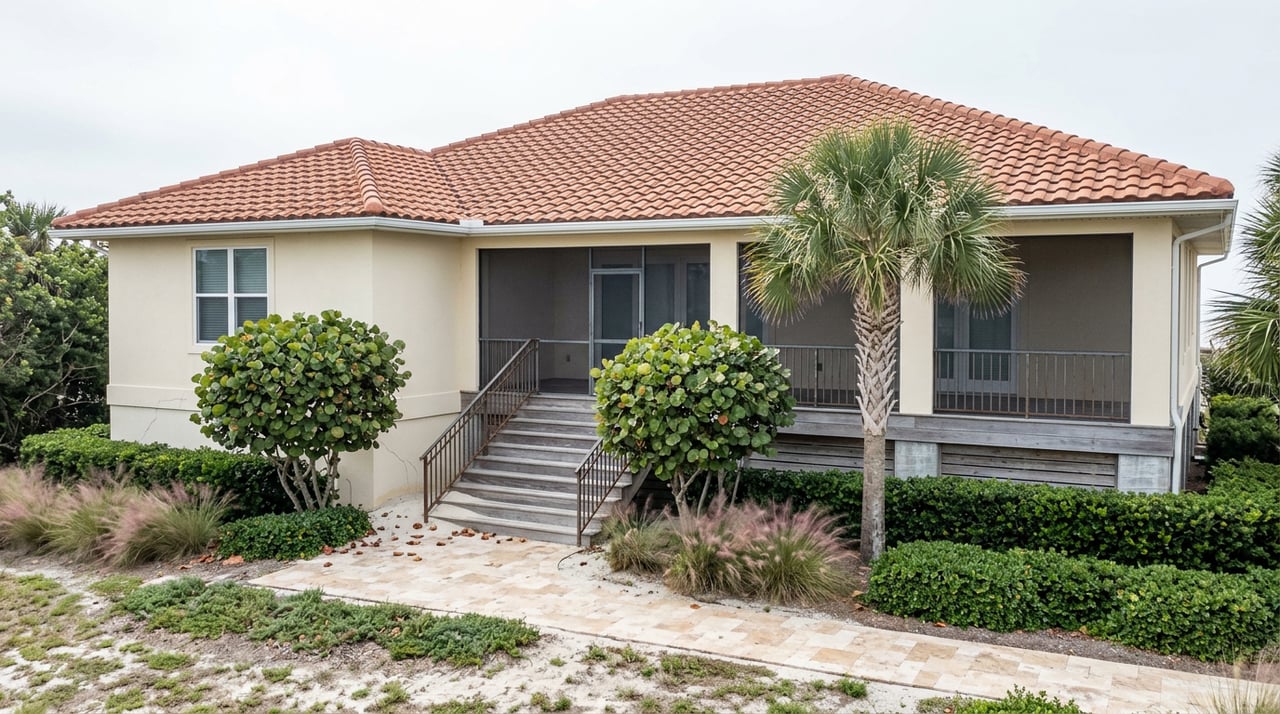
The property at 1198 Mandalay Point has a 3,434-square-foot home built in 1987 by Edwin Rhodes Hunter, who had owned the Clearwater Beach Hotel since the 1950s before selling his stake and eventually building this retreat for his own family. The house sits 20 feet above sea level with water views from every room, a deep-water dock rated for boats up to 80 feet, and a private road as its only land access. It's the northernmost of just 11 homes in the gated Mandalay Point subdivision, one lot removed from the wild, boat-only shoreline of Caladesi Island itself.
The asking price has moved around in a way that tells you something about how thin the buyer pool is for a property like this. It listed at $37.5 million in 2024, dropped to $27.5 million in August 2025, then went back up to $37.5 million that October. A $10 million round trip on a single listing isn't a sign of a hot market. It's a sign that this parcel doesn't fit the normal Clearwater Beach housing market at all. Nobody is comparing it to a condo on Mandalay Avenue or a bungalow near Pier 60. It's competing against almost nothing, which is exactly why a government agency, rather than another private buyer, is the one circling it now.
Why the state wants it
Caladesi Island State Park has one structural limitation that's shaped its identity since it opened: you can only get there by boat or ferry. Buying the Mandalay Point parcel would give the state its first real shot at a land connection to the park. Public records show the sandy shoreline on the property could also serve as nesting habitat for sea turtles and shorebirds, including the American oystercatcher, snowy plover, and least tern.
There's a longer arc here that current residents may not know. The fight to protect this exact stretch of barrier island dates back to the 1960s and 70s, when a developer had plans to quadruple the size of what's now Honeymoon Island, adding finger canals and thousands of housing units. A local advocacy group called SAVE, Suncoast Active Volunteers for Ecology, organized against dredge-and-fill development along Sand Key and Clearwater Harbor before turning its attention to Honeymoon Island specifically. Dunedin's mayor at the time, Gerald Rehm, pushed to keep Caladesi undeveloped, and the state made its first payment to acquire Honeymoon Island in December 1974, eventually opening it as a park in 1982. Mandalay Point is one of the last privately held pieces of that same barrier island chain, which now also includes Anclote Key Preserve. If this purchase goes through, it closes a loop that's been open for half a century.
Clearwater Mayor Bruce Rector made that framing explicit in a letter urging the state to prioritize the deal, writing that the purchase
would ensure that future generations can experience and enjoy Florida's natural beauty.
Brian Aungst, the land-use attorney representing the seller, put it in even starker terms when he first pitched the property to state officials back in December 2025, calling it one of the greatest conservation opportunities in the county's history.
The gate nobody's resolved yet
Here's the detail that separates this from a simple good-news land deal. When the Tampa Bay Times pointed out to state officials that the only apparent road into the property runs behind a private gate, the agency's response was that it's still in the feasibility analysis phase, meaning there are a lot of unknowns. That's a fairly candid admission for a state agency to make in print. It means the people pushing this purchase don't yet have a plan for how the public would actually walk in, even if the land itself becomes public.
There's a second open question sitting right next to it: whether the house comes with the land. A map the state presented in February 2026 showed the home at 1198 Mandalay Point inside the proposed purchase boundary. But the numbers don't quite line up. The Department of Environmental Protection's own Florida Forever listing describes the target parcel as roughly 12 hectares, which works out to about 30 acres, while the full estate on the market runs 42.57 acres. That gap of more than a dozen acres is exactly the kind of detail that suggests the state's actual target may be the undeveloped coastal fringe rather than the developed home site, even though the February map drew the boundary around the house too. No formal offer has been made, and nothing about the home's fate is settled.
A few things are still unresolved as of this writing:
- Whether the state's eventual offer, if one comes, would include the 1987 house or just the surrounding land
- How the state would resolve public access given the private road is currently the only way in by land
- When a formal offer might actually be presented, since the agency has only confirmed it is appraising the property
- What happens to the other 10 homes in the Mandalay Point enclave, none of which appear to be part of the current discussion
Why this has taken years, not weeks
If you're wondering why a story about "the state wants to buy this land" reads more like a slow bureaucratic crawl than breaking news, that's because it is one. Public records show the state began discussing the purchase as early as December 2025, when Aungst first brought the proposal forward on behalf of the seller. A ten-member state land council voted in February 2026 to add the property to the list of parcels eligible for conservation purchase. By June 2026, the Florida Department of Environmental Protection had placed the roughly 12-hectare property on its Florida Forever acquisition list. The Times story from August 31, 2026 is essentially the moment this nine-month process became visible to the public, not the moment it started.
That timeline matters if you live on Clearwater Beach and are wondering whether to expect trail markers and a new parking lot anytime soon. Conservation land purchases at this scale typically move in years, not months, and this one still hasn't produced a formal dollar offer. The most honest way to describe where things stand is that the state has decided it wants this land enough to put it on a shopping list. It hasn't yet figured out how to pay for it or how the public would use it.
What it means if you live here
For residents on the north end of the island, this is worth tracking less for what it changes today and more for what it protects long term. If the deal closes, it permanently rules out any future development on one of the last untouched stretches of Clearwater Beach, and it puts the northern tip of your island one step closer to being physically connected to a state park that's currently reachable only by water. Neither of those outcomes changes anything about your commute, your HOA dues, or your view tomorrow morning. But it's the kind of story that's easy to miss in the news cycle and then wonder, a few years from now, how that quiet gated stretch at the north end of the beach turned into an actual trailhead.
If you're curious about how land use decisions like this one tend to ripple through property values and buyer interest in specific pockets of Clearwater Beach, that's exactly the kind of neighborhood-level read Drift Home Realty tracks closely. Reach out anytime to talk through what's actually happening on your stretch of the island.
